bad at math
I failed college statistics twice, almost a third time. I passed discrete math only by the grace of one of the most aggressive curves imaginable. My entire career in cyber security and software development, I’ve avoided math like the plague.
And wouldn’t you know it, math did not avoid me.
Since graduating, cryptocurrency (“math that has become money”), finance (“money that has become math”) and AI (“math that has become conscious”) have taken over the world. Quantitative finance moves my net worth up and down, statistical models have become the mode by which I produce most of my code, and cryptocurrency has gone from “that thing they use for hypergambling” to something that I begrudgingly admit might be incredibly important over the coming years.
In short, it’s become much more inconvenient to be bad at math.
On self-limiting beliefs
I’m not big on “woo”: you won’t find me charging crystals or reading tarot cards or doing Ouija boards.
I have read a lot of self-help books though. Most of them are very bad. In fact, most of them I have not finished. I get just far enough in them to recognize that they’re mostly garbage and I move on from them. Giving up on books before I’m finished with them is a skill I started last year and it was a good one.
One constant throughout these books, though, is the idea of a self-limiting belief. It’s fairly self-explanatory, but it’s powerful so it’s worth grasping: a self-limiting belief is a belief that you hold on to that’s holding you back. Logically, there are a ton of self-limiting beliefs that are legitimate and honestly probably should hold you back, so we’re not talking about the belief that one is the Messiah come to save the earth from destruction. We’re talking about the belief that you are destined to be poor, that you’re destined to be lonely, that you’re destined to be anxious or fat or angry.
Or that you’re destined to be bad at math.
I don’t know why I’m bad at math (yes I do)
I was a lazy college student. I coasted through computer science courses in college because they were, for the most part, extremely easy. The rest of the courses, from English to History, were entry level courses that I could coast through without paying attention to.
The only classes that gave me any trouble were mathematics, and physics, which I sucked at because of the mathematics.
There is a very good chance that I sucked at math in college because they were the only classes I had to work at, and I was lazy. I guarantee that’s a large part of it.
That said, I wasn’t particularly good at introductory algebra or physics in high school, and I haven’t really been good at mathematics since. Same rule applies: I was lazy in high school, and am less lazy but still tend toward laziness now.
So maybe it’s less that I’m bad at math and more that I’m a lazy learner.
I need to fix this. Leaving a blindspot in one’s capabilities simply because one is lazy or has limiting beliefs holding them back is a recipe for disaster in a modern world that is changing as fast as ours is. Math rules the universe, it is the only constant around us that we can reasonably depend on, so letting that be a massive blindspot weakness for me really is a non-starter.
Planning and goals
So I’ve decided to become better at math. It’s a wide field of study, so it would be best to focus in on some specific focuses.
The obvious would be the statistics necessary to better understand machine learning and artificial intelligence research. Here’s where I tell on myself again: I’ve gone down this road before (learning mathematics) so I already have a couple books that I know are a good start.
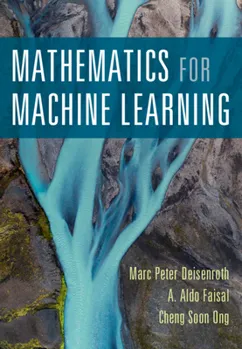
Mathematics for Machine Learning (amazon affiliate link) will be my starter. I’ve started it before, and it gives a good overview of the field. I’ll supplement that with a healthy dose of other resources as I go, I’m sure.