Exploration Transforms Into Consolidation
Exploration Transforms Into Consolidation
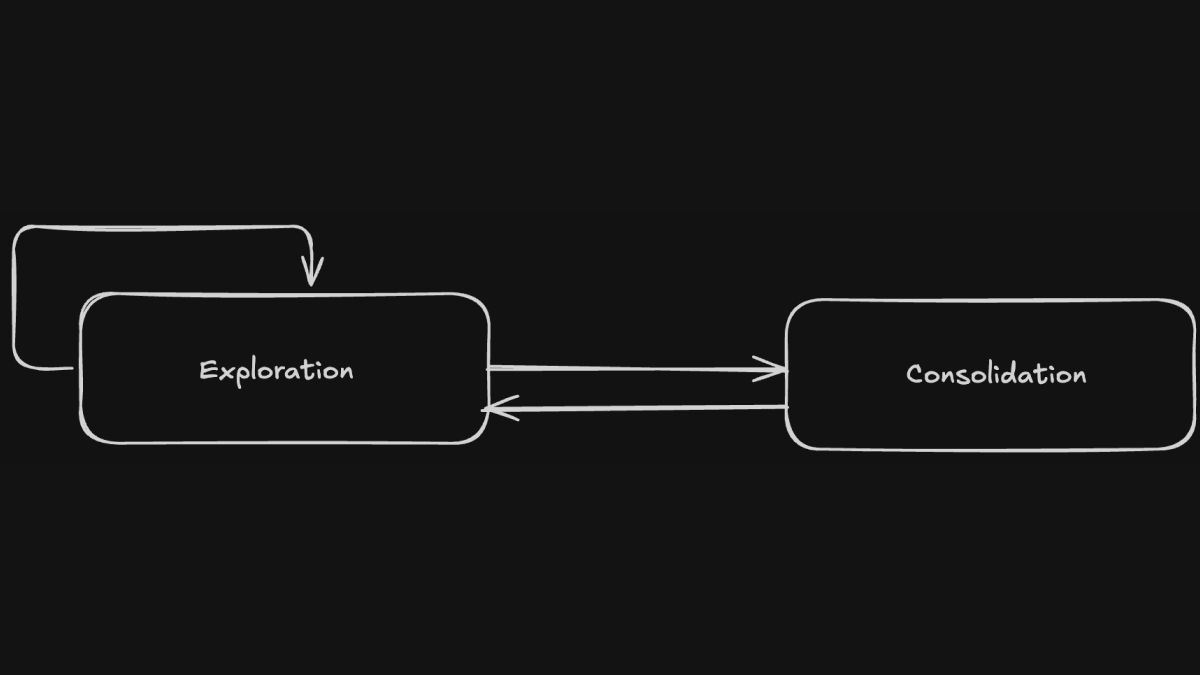
Over the last year, I’ve been working on a lot of different projects. I don’t know that I intended it to be this way, but 2025 was the year of exploration for me.
I started building SocSim, a 3D environment where agents will be able to build and simulate societies. I am building this in Godot and plan to launch it this year.
I started building FanShi, a Rust/EGUI-based dashboard For Everything, basically a personal dash where I can do everything from prompting image gen models to drafting blogs and tweets.
I started, worked on, abandoned and came back to ScrollWise, a SaaS framework for archiving content via a web browser plugin and using it to inform LLM queries.
I started and stopped various other projects, not really “launching” anything as much as I was exploring.
In hindsight, this wasn’t intentional, but it was incredibly formative for what I think is the next phase: consolidation.
Philosophical Consolidation
Thematically, I’ve realized that a lot of the thematic elements of these things can be consolidated. SocSim is an attempt to explore emergent behavior from AI, a way of exploring how AI thinks and how different agents would interact given an environment that, as much as possible, mimics reality. Curiosity is the big theme here.
Fanshi was an attempt to break out of the highly addictive, dopamine capturing browser-space so that I can be more productive. It’s a way of creating a “personalized” space in a world where the web has more or less demanded we all sit down, shut up and accept the space that capital has built us.
ScrollWise was a realization that the average person is forgetting, or basically throwing away, 90% of the content that they scroll past, missing out on content and insights that could be truly valuable. It’s a realization as well that the benefits of AI are being heaped upon those with the power and knowledge to use them, and the Average Joe is missing out on a lot of it.
Outside of the technical projects, I have developed my own politics and philosophy considerably. Radical techno-progressivism in the form of h/acc has been one of my primary foci: how can we build a movement that embraces the importance and transformative nature of technology while eschewing the authoritarian concentration of power innate in our current environment?
Decentralization and federation, two organizing but intentionally vague philosophies, have become very important to me as I’ve realized that a lot of the woes that we are struggling through now are a result of the centralization of political, economic and cultural power. Federation, in my opinion, is one of the primary ways that we can scale a decentralized and largely-voluntary society from a governance perspective.
2026: The Year of Actualized Consolidation
As the philosophical consolidation has become more clear in my mind, I’ve begun to think about how I can consolidate my technical projects to build something that is far more impactful. Sitting on my back porch enjoying an unseasonably warm January day, it came to me.
The answer has always been People’s Palantir.
Fanshi as a dashboard consolidates all of the things you (or, currently, I) care about. Now it’s just a ToDo list app, but what if it had social media feeds, stock tickers, RSS feeds, windows for interacting with LLM’s?
ScrollWise was focused on siphoning social media data, but what if it could be used to capture Everything You Consume in the Browser? What if it archived YouTube video transcripts as you watched videos, vectorized them, put them in a database that you could read later, but also pulled out information from a PDF you’re reading and did the same?
What if all of this was hyperlocal, privacy preserving and customizable, even open source?
What if you could host your own data servers… and federate them with others in a zero trust way?
All of this exploration has lead me to some guiding principles. The browser is an awful place and should be avoided wherever possible. It’s built to be anti-human and all of the software on it is highly focused on ensuring you view as much advertising content as possible. The answer to this should be native, customizable and resistant to ads.
Social media has largely failed, but dark forests can be an answer. Dark Forests, or small groups of individuals who off-platform to Do Cool Stuff, are inherently open to Federated Models: each small group is going to have various interactions with other small groups through some sort of actualized or informal model. These federations, even if informal, can form small simclusters of related small groups.
People’s Palantir is an idea I had at the beginning of last year that I thought I’d abandoned but I’d actually been Exploring Toward all year. Palantir is a piece of software that governments (mainly) use to ingest large amounts of data and build pipelines on that data, primarily for organizing the logistics of Killing and Surveilling. The strength of Palantir is supposedly that it’s fairly good at taking unstructured or multi-structured data and structuring it in a way that’s more useful for decisionmakers.
Say you’re an analyst at the NSA and you have several terabytes of phone surveillance data from TMobile, and your homie at the FBI has several gigabytes of Stingray surveillance data from a protest, and you want to comb through that to find enough information to put an activist in jail for Thought Crimes. This would take an extremely annoying processing stage to comb through all that data, collate it, build a very flimsy case to bring to a judge who will rubber stamp it anyways and let you go and arrest the guy. Palantir, supposedly, makes that process a lot easier by ingesting all the data from several sources and analyzing it to make it easier for Palantir users to infringe on the rights of dissident citizens.
If it’s not abundantly clear, I’m not a huge fan of the company that made Peter Thiel the thorn in democracy’s side that he’s become today. It’s run by evil people for evil purposes, and though its capabilities have been massively blown out of proportion, it’s a company that should be eradicated.
Anyways. People’s Palantir.
The average person has access to more data than they will ever in their life, or 100 lifetimes, be able to meaningfully use. Between social media, content platforms like YouTube and TikTok, endless audio books, podcasts and research papers, not to mention more granular data sources like macroeconomic data, stock price movements, elections, census, etc.
The average person is inundated with information, yet seemingly becoming less intelligent. This is because they are inundated with bad information and cannot process and act on the good information.
There are already startups and media outfits trying to fix this. GroundNews is one example, a site that helps folks consume media in a way that calls out or shows the biased representations of it. This is a good step in the right direction.
What I want to build is less for the Average Joe and more for the power user of information. People’s Palantir is for people whose daily trade is in information processing: content creators, analysts, journalists, infobrokers, etc. I want to give them the same ability that that NSA analyst has, not to surveil and kill, but to take decisive action, scalably, on good information, and to be able to spread their analysis to others if they choose to. I want them to be able to analyze the information environment that they’re wading in, to call out lies and hold their leaders to account. I want them to be able to form media apparatuses based on solid foundations, to use incredibly technical means to do data and citizen journalism.
This, I think, is where the exploration has lead me to. This is what I will be focusing on for 2026 and, likely, for a long time thereafter.